The Show is Not What it Seems

So I’ve gone and binge watched Twin Peaks. As per The Prophecy and The Rules, I’ve also gone and buried myself in Internet fighting about what the show meant, both textually and in the context of society. Reading the resulting conversations has got me thinking a bit about the tendency of critics to elevate pop culture to something to deconstruct. There’s absolutely nothing wrong with that, and, sure, if you want to deconstruct The Apprentice as a way of looking at commercialism, or The Walking Dead as modern drama, then have at it – who knows, you might win some new converts. However, there tends to be some serious tonal blindness that comes into play when discussing pop culture, and it’s been something that’s been on my mind since well before I watched Twin Peaks. I’m going to go out on a limb here and make a statement that might not really matter: Twin Peaks, at its heart and soul, is not pop culture. The Avengers is. Joss Whedon may be making smart pop culture in The Avengers, but it’s still pop. But, we’re getting ahead of ourselves. Let’s discuss this.

First, The Avengers is a Marvel property that is based in a comic book universe where magic and science interact with each other; being bitten by a radioactive spider will give you superpowers; and a dude literally covered in tumors and feeling nothing but pain can still crack wise all the time. It is a universe where silliness and levity reign supreme. It’s a universe where surrealism is stripped of dreamlike quality and is given a shiny, packageable material, and that is fantastic. However, I’ve consistently been a bit weirded out by the hawkeyed gaze that a lot of people use to discuss the ins and outs of the ethics of SHIELD using a city as a battleground. The thing that separates Marvel from DC, and – frankly – makes Marvel much more successful at the comic book movie game, is that Marvel realizes the inherent nonsensical nature of the films’ universes. It’ll continue to do so, I believe, until the Civil War storyline pops up, and Marvel starts getting social criticism injected in its films. But even then, I think, we’ll see the Stan Lee touch that keeps the things light, whereas DC throws pathos and seriousness at audiences with gravel voices and screaming ubermenschen.

The hawkeyed gaze may best be seen in comment sections, where commenters state that they couldn’t buy the simplicity of Guardians of the Galaxy. There’s something deeply wrong with going into a summer blockbuster movie and thinking that it’s too tonally close to a summer blockbuster movie. Yes, GotG is chock full of accessible plot points, familiar tropes, and your basic, hashed over again and again revelations. However, the movie is not meant to be breaking cinematic ground. The movie is meant to put a new face on already trod upon territory, much the same way that Whedon’s Avengers did. My beef with that sort of criticism is that it applies a Film Criticism outlook on something that is, most assuredly, not going to win the Sundance Film Festival.

On the flip side of this is a TV show that aired in ’90 and ’91: Twin Peaks. Created by David Lynch and Mark Frost, the show uses the murder of a teenager as a springboard to introduce the overall weird into a soap opera context. The show, I think, has two parts to it. The soul and the skin.

Let’s first take a look at what I think of as the soul of the show. Debuting on ABC at a time where TV wasn’t smeared with heavy-handed (yet well-written) prestige TV, the show had some incredibly bizarre and harrowing moments. It deals with rape, murder, envy, childhood molestation, and the inner demons of what we think of as normal, safe people. Yeah, you could see things like this on TV today – take a look at AMC’s lineup for a cable example, and HBO for premium – but the true hint of what the show really is comes into play in the vision aspect, which is most prominent in the episodes where Lynch is at the helm.

In these episodes, where entities speak in bizarre, quasi-backwards speech, where time stands still in red velvet-draped rooms, and kindly men are very insistent that you drink your warm milk before it goes cool, we’re treated to a dreamscape unlike anything on TV. See, TV is not film. TV cannot be film. TV is ubiquitous. It is the stuff of watercooler discussions in offices worldwide. TV is exported wholesale. If you, as an American, go to Europe, you can be safely assured that Friends or Frasier will be on TV. (If you go to Lebanon, Seinfeld. They seem to like Seinfeld in Lebanon.) In order to be ubiquitous, and in order to communicate even the most basic of messages, TV must speak on certain wavelengths: Romance, low-level intrigue, murder, and a good hint of not-quite-shown-but-more-than-hinted-at sex (yadda yadda yadda) are the lynchpins of a successful show because they’re – by and large – things producers and writers can count on as being accessible to a wide range of people. Film, though, has more freedom by the sheer fact that not all film is Hollywood. Anyone who says that it is, is probably also under the impression that all comics are Marvel/DC, or that all video games are Call of Duty. Every national tradition has this duality in film: Commercial and “art house.” You’ll find the more banal in commercial, stuff ranging from The Avengers to Michael Bay’s Transformers, but in the art house is where you find the interesting, the non-pop, the bit more of freedom.

(Assuming I want to be hand-wavy, dismissive, and make a wide, general statement – which I kinda do –  we’ll say that there doesn’t have to be as much hugging and learning in art house.)

The art house, at least as far as I think of it, isn’t really concerned with making millions, or turning the one-off into a series, or milking something for everything it’s worth. When you don’t have that concern, you’re more able to act in a way that pleases you, the creator, and thus, allows you to create something that’s more personal and means more – not necessarily to a wide swath of humanity, but to those who get it.

The heart and soul of Twin Peaks, the episodes where Special Agent Dale Cooper, the Palmers, and Windom Earle, are visited by entities in visions, live in the art house. These episodes are helmed by Lynch, and one or two other episode directors who were on the same wavelength as Lynch as to the heart and soul of the series. And, as you might expect from the guy who brought you Eraserhead, there’s a lot of weirdness. True weirdness, mind you. Not that brand of weird that’s more randomness aping Monty Python – or Lynch. The weird, as Lynch understands, is the sublimely unnatural forcing itself onto the natural. It’s those moments that bring out what I think of as true horror: That idea that there is something deeply wrong with the world, and that there is absolutely nothing will stop that wrongness from slithering out.

But the thing – the unique thing – about Twin Peaks is that it brought that weirdness to TV, instead of allowing it to fester on film. It did so, though, in an immensely enjoyable way: It magnified soap opera melodrama and forced it back on its viewers, becoming the skin of the show. One question that a critic brought up about the show was that viewers at the time were trying to figure out just what it was that they were watching. One critic suggested that it was pretentious of Lynch and Frost to say that they were not making a detective show. And there’s a little truth to that, because the core of the show revolves around Cooper’s investigation of the murder of Laura Palmer. But the critic got it wrong: The show is not a detective show. It’s a representation of nightmares birthed out of horrible occurrences: Chiefly, murder and molestation.

The show lives on TV, and in doing so, it presents its soap opera face. Think about it, we’ve got conniving businessmen, people who are not what they seem, more extramarital affairs in the show than there are cast members, and, yes, this fact is telegraphed by the first season’s sub-show, Invitation to Love declaring plot points minutes or scenes before they happen. Both the first season and the second season have so much soap opera plotting going on that it’s similar to learning not to smoke by being forced to smoke a carton of cigarettes in one go. And, yes, this does mean that at times the show is gratingly slow or bafflingly frustrating, but that’s more proof to the fact that it’s actually art-masquerading-as-pop.

A quick note: There’s going to be spoilers from here on out. Yes. This is a spoiler warning for a twenty five year-old show. The Internet made me do it.

To marry our two statements above, I’d like to put this forward: If we’re looking at the show, then the heart is BOB, and the skin is Leland Palmer. Palmer is the socially-acceptable, presentable, likeable, mass appeal of the show, and BOB is the nightmare lurking at the heart of it; the reason that it is the way it is. Just as Palmer is a mover and shaker in the town, and is not what he seems, the Lynch aspect of the show is the true heart of it – that portion of the show that makes it so memorable, and what makes it still present in the cultural memory and makeup, twenty five years after it aired.

But then we run into a problem: If we’re looking at something that’s supposed to focus on the weird and nightmarish, then why is so much of the second season given over to the mundane and the soap opera? Well, there is no defending James Hurley. The character is Mr. Pout, and he inevitably ruins every scene he’s in past the point where BOB kills Maddy. I’d like to be able to say something about how James and his storyline are representations of such and such, and how that means this or that, but, frankly, the only thing I can say about his character is that he is a one-note riff on the James Dean tough guy image that should have been kept to a minimum. Just bad writing and direction whenever his storyline takes center stage.

But! Beyond that splotch on the show, the mundane and the soap opera, as mentioned before, is Lynch being Lynch. He is, in fact, giving the viewer what he wants: TV that he has seen before, and will continue to see after this show is gone. And, as the show moves from telegraphing plot points from a soap opera, that mentality is moved from TVs within the show to actions on the show. Characters begin speaking in non-Lynchian. They act like you’d expect from a network show – granted, with a bit more blood and oddness thrown on, but the core, the melodrama of the 90s drama, is still right there on the facade. Josie Packard acts just like a widow of a wealthy industrialist would do on TV; Ben Horne is as much as a snivelling greedy bastard as can be (until he goes insane, at which point, Jakoby is a cliched shrink babbling pseudo-Freud); and teenagers are teenagers. The mundane is forced on the viewer, much like BOB forcing himself on the Palmers.

The practical reason for the middle episodes – from BOB finally showing himself in Leland to, I’d argue, Annie’s appearance in Twin Peaks – being farmed out to other directors (like Diane Keaton!) was that Lynch had other commitments to work on. However, assuming we buy the idea that these episodes are meant to forcefeed soap operas until the viewer cannot take it anymore, then it works. Can you imagine Lynch trying to make James’s storyline work? There would have been giants and turkey babies all over the place. While there’s little memorable in this portion of the series, it’s important to remember that a facet of Twin Peaks is throwing the cultural phenomenon of pop TV back at the viewer. Thus, potentially, having the godawful James storyline play out over so many episodes, is incredibly important. Even though it may be incredibly painful to watch.

The importance of all of this, and the reason I’m writing this thing in the first place, is that while the show happened on network TV, referenced pop culture, and, indeed, became ingrained in pop culture it is nowhere near pop culture. This is why a lot of people have some problems handling the more melodramatic aspects of the show, and why they seem to fall flat. You can only keep up a ruse for so long. Even BOB couldn’t keep from making Leland dance like a bad ventriloquist act.

Again, because I get accused of being an elitist a lot, there is nothing wrong with a show being pop culture. And if pop culture is your thing, then that’s fantastic. And if you want to deconstruct pop culture, then that’s fantastic. However, that doesn’t mean that just because something puts on the mask of being pop culture, that it is pop culture. A further two metaphors: Just because something appears on The Simpsons doesn’t mean it’s pop, and just because you appear to have a very affable and friendly lawyer doesn’t mean you don’t have an otherworldy, demonic, murderer-rapist spirit on your hands.

The TV show is not what it seems.


Anniversaries, Pt. 2 – Colorado

I hit the Colorado border, around 6:30pm local time that night, as the sun was setting. A few hours before, I’d called up an old high school friend who’d moved out there after college, and managed to bum a night’s sleep on his couch. He lived in Colorado Springs, which wasn’t too far from the border, so I’d crash there and then, in the morning, continue on to Grand Lake to see my uncle, by way of Denver.

The first thing I thought of when I got out of the car to fill up at a gas station in a small mountain town was “Holy shit, I haven’t felt sixty degrees in months.” It was September and there had been oppressive heat all the way from Nashville. But up in the mountains, it was sixty degrees, and I wished that I’d brought my jacket along. The other thing I thought was interesting, which probably no one else will, was that there was a USAA ATM. The incredibly easily-pleased portion of my brain (which is most of it) went “Oooh,” and I took out money. Without getting charged a fee.

It was glorious, and, with this experience, I knew that I had made the right choice in coming West. Some cultures have their heroes receive good omens in the forms of augury, or being told a fortune, or any number of other things. My good omen, it turned out, was taking money out of an ATM without being charged. Look, you take what you can get.

So, naturally, this being America and we being two old friends from high school, we went out drinking in town and did the whole reminiscing and catch up thing.

Nathan, it turned out, hit the same realization that I had hit a couple of times before, but was only now acting on: He had to get out of Tennessee before it wrecked him. It was, you see, the hometown effect. I’d lucked out and a) not actually been from Smyrna, b) never really enjoyed living there, and c) moved to Nashville after high school, immediately before going to college. I had avoided the hometown effect. For him, though, he fell into the trap of being in the same county for a good chunk of his college career. Of course, he got out, went West, and things seemed to be working out for him.

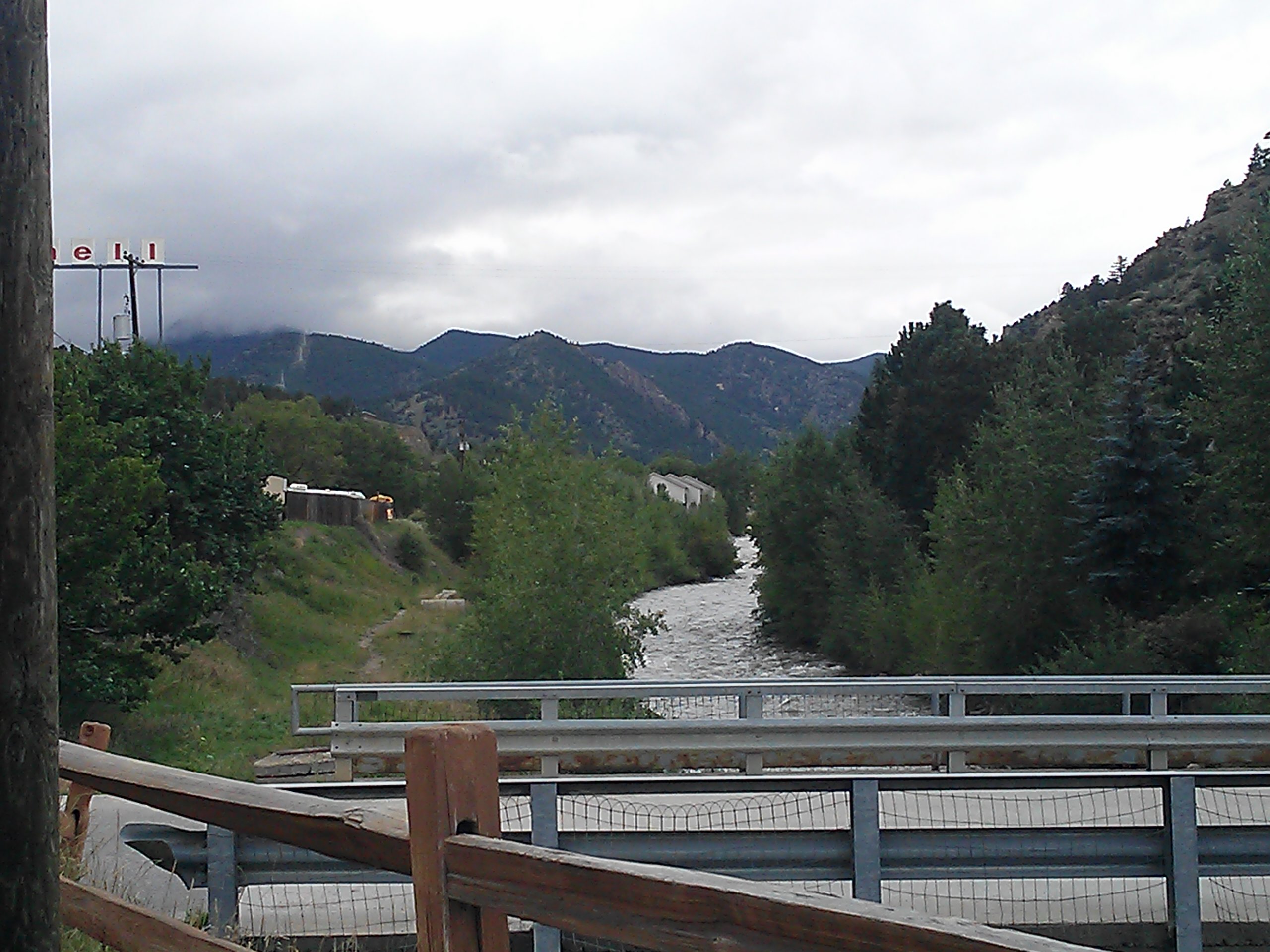
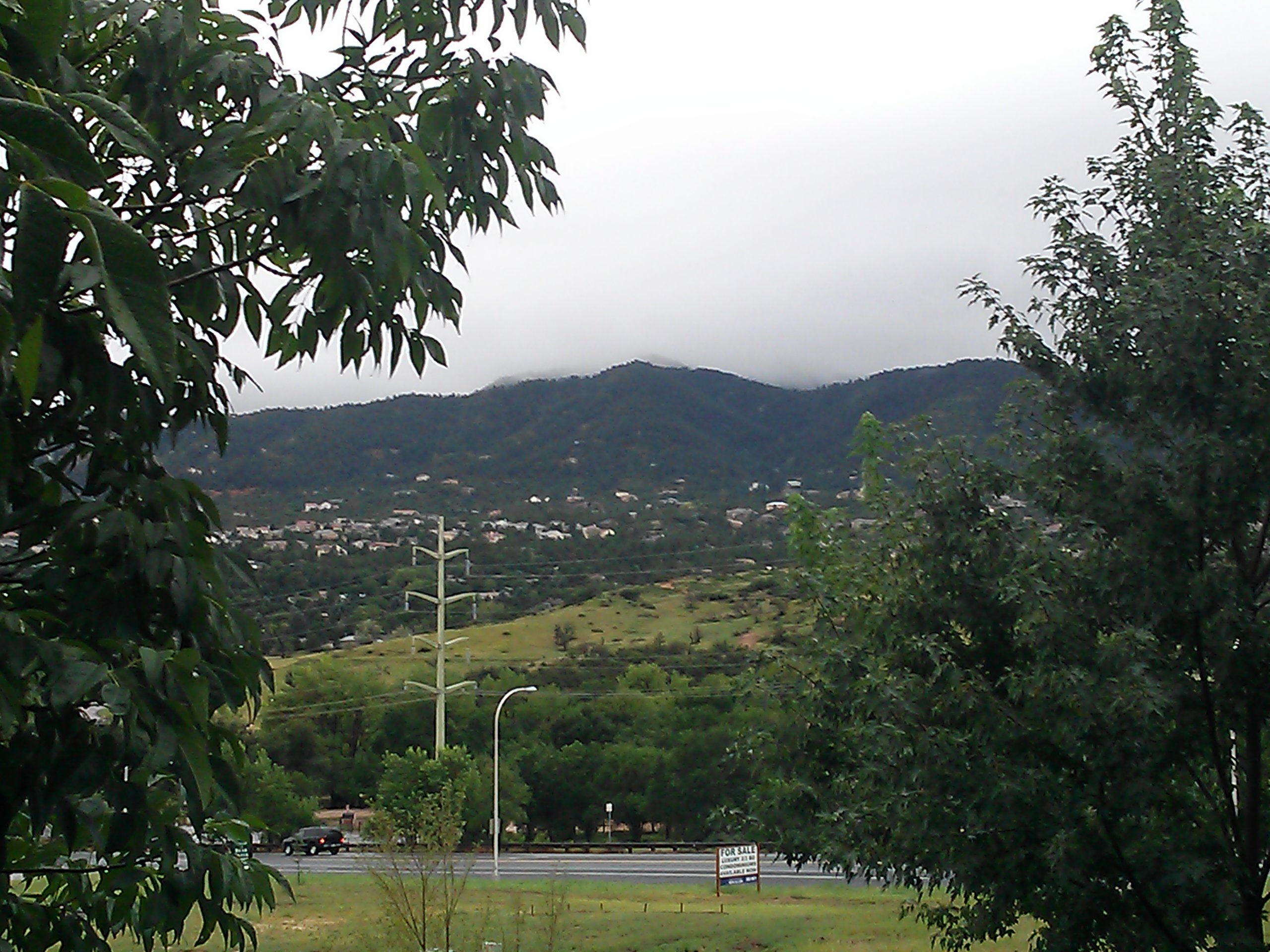
We drank for a while, went back, and then I crashed around midnight. I woke up the next day to some great scenery—

2013-09-12 09.18.21

—and started on the road after waking him up. (It was eight am! Civilization starts at 7!) I went up the interstate from Colorado Springs toward Denver, keeping an eye on the mountains to the west. I still wasn’t quite sure that those things were really there. Part of me thought that I was still in Kansas, wandering around the great wheat deserts and flatness that makes up the entirety of that state. But the mountains persisted, and that was good enough for me.

I passed through Denver pretty fast. I’ve got fond memories of the city from visiting my Uncle Mike a few times over the years, but just about zero knowledge of anything in the city limits. I did, however, stop off at a Starbucks and watch the rain for a bit, so that was nice. I thought that it was raining a lot for an area that was technically desert, but shrugged it off and went on my way.

The rain continued on as I went West out of Denver and into the Mountains, passing through a place called Idaho Springs—which is where I took this picture:

2013-09-12 15.39.30

—and then followed a few county roads to Grand. Along the way, I passed through a town called Granby. According to Mike, the only reason people know about Granby was because, in the early 90s, a man who’d gone to the area to disappear from the radar found that he couldn’t quite do that. So he decided to try and take out a loan in order to successfully remove himself from society, failed at that, and then decided that, society be damned, he was going to weld a bunch of metal plates to a truck, make a tank, and bulldoze his way into the bank and get the money one way or another.

As you might expect, that did not end well for him.

But, aside from that not so great past, Granby’s a pleasant-enough looking town. It’s got one main street that’s full of small shops, a locally-operated hardware co-op, and then a supermarket. It’s also surrounded by amazing countryside and quite unlike the more wealthier towns that lead into Granby from the highway. There’s a good chunk of me that would really like to move to a place like that, since there’s not a whole lot of distraction aside from, you know, the entirety of fucking nature, and that would really make it easier to write, but, again, I do love me some high-speed Internet.

After fueling up at a gas station in town and looking around me at, well, this:2013-09-12 17.18.00

I hit the road again. From Granby, it was a short enough drive to Columbine Lake, where my uncle and his wife, Mary Ann, had their home. The thing that struck me about the area was that it was so different from Tennessee. I’m not talking about people-wise, because, frankly, there weren’t that many people, and those who I was around, I didn’t really speak to. I’m talking more about the terrain and—not to get too New Agey—the vibe of the area. The energy, to get very New Agey. I’ve lived in a few places, and, by and large, they’ve all been temperate foresty-type environment, or, in the case of Canton, a mix of suburb and late urban biome, which is, itself, quite unnatural.

Houston, of course, doesn’t count. It’s nothing but concrete, heat, and mosquitoes down there, and it’s best avoided at all costs. Yes, there are a few trees, but they’re safely confined in people’s yards or in parks, where they can’t hurt anyone. Nature isn’t nature in Houston. Nature is adornment.

Even England was pretty similar to Nashville. Woodsy hills with farmland looks like woodsy hills with farmland, despite the change in people’s accents.

But Colorado was hugely different, and made moreso by the change from the unbearable flatness and madness-inducing Great Plains. The trees in the South are densely packed. You drive through the state on the interstate and you notice that, in the spaces between cities, it seems like you’re going through a jungle. Not only that, but there’s a huge array of wildlife out there, just lurking in the woods, waiting to strike out and take out travelers who aren’t paying attention to their surroundings. (I, uh, don’t really go camping or anything. Deer are carnivores, right?)

Colorado, though, being high desert, was different. The plant life there mainly consisted of evergreens and low brush. And those evergreens that were around were smaller than you’d expect in many places, mainly due to a type of beetle that came through about eight years before and wiped out a staggering amount of trees. But one of the things that struck me the the most was the water. It was so clear. Just crazy clear. Mountain spring water clear. I know, I’m sounding like someone who’s never been through the mountains. Well, that’s mainly because that’s true.

Sure, Knoxville was right next to the Smokeys, but I never really made it up into the Smokeys. And besides, comparied to the Rockies, the Appalachians are foothills. Rolling, relaxed, inviting terrain that wants you to come through, spend some time in them, and maybe perhaps brew up a thing of sweet tea while you’re at it, though. The Rockies, though, are something out of a Dvořáksymphony. They are gigantic peaks, huge slabs of rock jutting out of the ground and not so much inviting you as demanding that you pay attention, damn it, because there is something that is bigger than you, and it is the world.

Paired with that train of thought that had stayed with me ever since I passed out of Idaho Springs and saw this:

2013-09-12 16.33.57

and had to pull to the side of the road and just stare, was a whole slew of minor surprises, like mountain spring water. Also a minor surprise: Moose exist, and they are massive. Turns out that there’s a family of moose by my uncle’s place, and they’re not too shy about being around people. Again, this may seem like a weird thing to be surprised by, but I’m very much a city guy. I like the anonymity of being one of millions in a concrete jungle (as long as that concrete jungle isn’t Houston), but I also like the whole nature thing. Of course, moose, as a rule, don’t live in cities, so I have never had a chance to see one just hanging out on the side of the road, watching traffic.

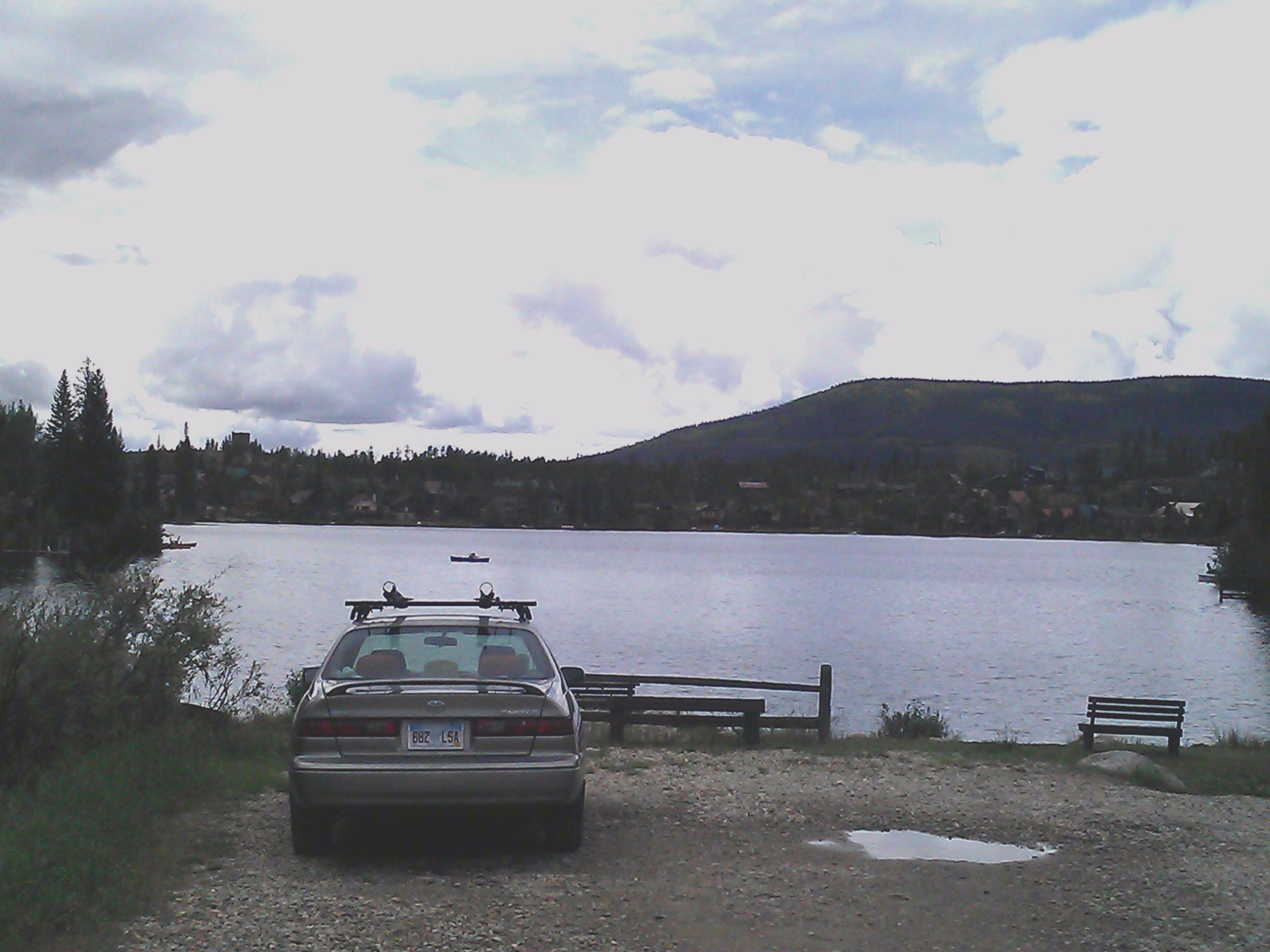
So, I pulled up to my uncle’s house in Grand Lake, where the lake was stupid clear, the weather was crisp, and just a couple of miles away as the crow flies was the Rocky Mountain National Park. It was just a bit different from the suburbs of St. Louis where I’d been the day before, the not-so-pleasant looking city of Kansas City, and what turned out to be the (seemingly) endless sprawl of Air Force bases in Colorado Springs. (Which, also, explained why there was a USAA ATM.)

For a long time, my friends and I in Tennessee would go “camping” every September. (There were electrical outlets, nearby showers, and easy access to Internet from a nearby marina, but we were in a state park, so it was camping.) One year, as we sat around the “bonfire” and tried to roast marshmallows in between rounds of screaming at each other over Risk, my friend Brad’s Dad, Glenn and I were going back and forth about a quasi-Zen idea of “The Quiet.” Basically, it’s the still mind in a sea of noise and action. That conversation has stayed with me for a long time now, and when I stepped out of the car next to Columbine Lake, I thought of The Quiet.

2013-09-13 12.50.51

I took a deep breath, sure, again, that I had made the right choice.

I stood there for a few minutes, just taking it in. Mike and Mary Ann hadn’t come back from their golfing excursion yet, but they’d left me the code to get into the house in a voicemail. I figured I had time to take in the scenery a bit.

I got my fill, pulled out my phone to get the code, and realized I had no reception to check my voicemail.

“Shit,” I said.

Anniversaries, pt. 1

A year ago today, at around this time, I was getting ready to pack my stuff in a rental car and drive across the country from Tennessee to Oregon. Along the way, I was going to stay with family in Missouri and Colorado, but beyond that, I had no real plan. This, by the way, has been a recurring theme in my life. I like going through things without too much a plan—honestly. No, seriously. Just ask people who I’ve traveled with. There’s something to be said for a bit of controlled chaos, and, certainly, driving across the country to make a home in another state with no job or housing prospects is pretty much a stupid idea.

That day, I remember hanging out on the couch drinking coffee and playing with my dog—LOOK AT MY DOG. LOOK AT HOW CUTE SHE IS:

2013-08-01 10.49.18

Chloe, wearing a makeshift thunder vest

and thinking that it was kind of messed up, but that dog would be the thing I missed most about Nashville. See, it’s not that I wouldn’t miss my friends and family there, but that’s a simple Skype call. And, I thought, it’d be easy to find a job in Portland. I’d roll up and with my Master’s degree, record of employment, publications, international scholarship record, and, yknow, Simon charm (HAH), be offered something right off the bat. But that dog, I knew, I wouldn’t be able to talk to on Skype. (It should also be noted that the Simons—at least in my odd little branch of that gigantic tree—have very strong, almost troubling connections to dogs. We’re dog people.)

So, as I backed the car out of the space at my mom’s condo, I saw her and Chloe in the rearview. Mom looked tired. I’m sure she was sad, but she was also tired and, if there’s anything I inherit from her, it’s the strong desire at any time to just go back to bed. The dog, of course, looked confused, as this was not a car she’d ridden in before, and thus, I had no business getting in it and driving off anywhere.

The sad feelings, however, didn’t last too long. I took 65 North and got out of Nashville, and as I saw the skyline recede behind me on the way to Clarksville, I said a string of obscenities that I’d rather not reprint here. Life in Tennessee had not been easy for a multitude of reasons, and while I’m very glad for those experiences, because they made me what I am right now, I’m also very, very glad that they’re over. There isn’t a whole lot that I’m sure of about my life, but I definitely think that getting out of that state was a wise choice. I’d say that it’s something everyone should do at some point, since it really forces you to look at what’s important in your life, and what you can live without, what really makes you keep going on, and what keeps you from being happy. Of course, that’s not quite possible if you’ve already got that whole family-and-kids thing going on, but, well. Dunno.

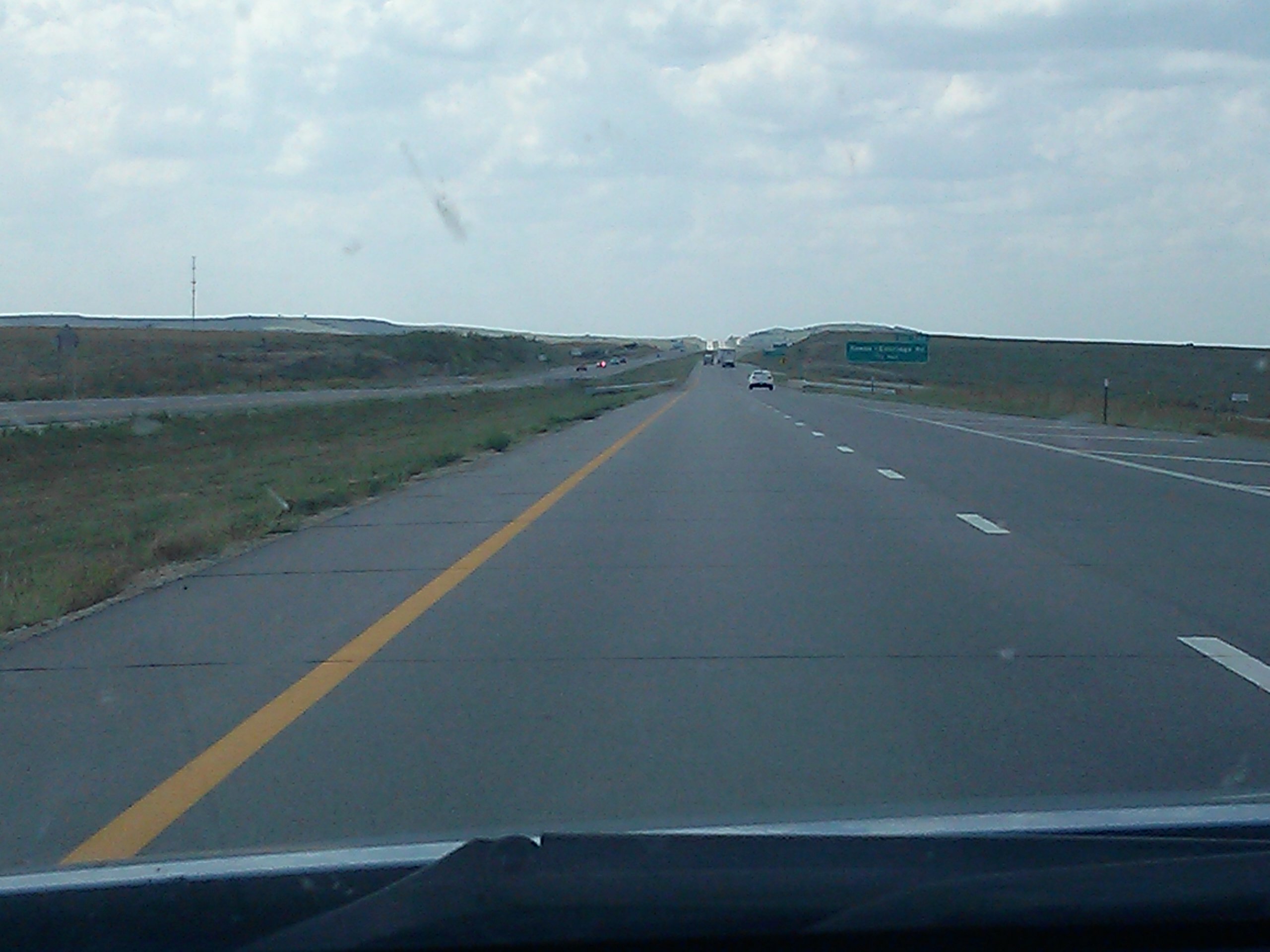
Anyway, In a couple days’ time, I was driving across Kansas. Kansas was flat. That’s all there is to say about Kansas. Flat and fields. Here. Look.

2013-09-11 14.17.59

Pictured: The highest elevation in Kansas

As far as the eye can see. At some point, as I was fueling up in some town off the interstate, I think I saw a tornado. At that point, I thought, “Well, it’s about time to start driving thirty over the speed limit and get out of this state.”

So, with that in my mind, I hit Colorado at sundown, and I remember the local NPR station finally crackling to life. (Yes, I was in an area that did not have an NPR station. That is how bad parts of Kansas are.) As I got within range of the station, to the point where I could hear the broadcast without it being in bursts, I heard Borodin’s “In the Steppes of Central Asia.” Listen to it below, but if you can’t, then know that it’s an almost Mahlerian exploration of a landscape. Not Copland, mind you, because Copland’s very, very American at his core. He wrote to be a populist, which is great, and Copland’s amazing. But Mahler wrote more to express what he viewed in the world. “In the Steppes of Central Asia” may be only nine and a half minutes, but, with the tone in the background, humming along like cicadas in summer, you’re not necessarily thinking of how beautiful the picture could be, but how staggering the expanse is. And that’s something about Kansas that’s striking. I wouldn’t exactly call it “beautiful,” but I would call it “staggering.” It’s the first taste you get of just how big the United States is. You don’t get a grasp of that on the East side of the Mississippi, really, because it’s a relatively highly-populated area. There’s a lot of land, yeah, but there are a lot of towns, roads, railroads, interstates, and signs of habitation. Kansas, and the Plains, and the Rockies, in large parts of it, it’s just you and the land. (And the other drivers, but allow me my Romanticism, please.)


So, with Borodin on the radio as I crossed the state line, and even with the Rockies fading in the distance thanks to the setting sun, I knew that the worst of it had passed. The bleak neverending expanse of Kansas, the just constant, unrelenting flat that led to me having a full-fledged conversation with myself about some really dark shit? That was gone. I’d lived through Kansas. Hell, I’d lived through sixteen years as an openly liberal, then openly socialist Jew-atheist-Buddhist-whatever-the-hell-I-am-these-days in Tennessee. Was there any surprise that I could make it through Kansas?

Reader, I say to you: Yes. There was.

A friend of mine once told me a story about a friend of his who was on the Interstate through Kasnas, between Kansas City and Topeka, I think, and was passed by this semi. Well, not only did the semi cut him off on the otherwise empty interstate, but he then jackknifed in front of him. So, my friend’s friend—call him Bob—peeled off the side of the road. If I had to guess, it was right then that Bob was thinking about that move, Duel, about the guy being chased down by a homicidal trucker. So Bob pulls off the side of the road, e-brakes, spins a bit, all that good stuff. As Bob gets out of the car, he looks up and there’s no semi. He imagined the whole thing.

What I’m trying to get through your skull with this piece is three things:

  1. Sometimes, if you’re in a well and true rut, then the best thing to do is to pack up and move elsewhere
  2. Know what makes you happy in life, pursue it, and know what makes you unhappy, and avoid it
  3. Never go to Kansas

Next time, I reckon we’ll talk about how amazing Colorado is.